
2 条题解
-
0
考场上和队友
luogu://user/747879树形态分析
先看一张示意图。
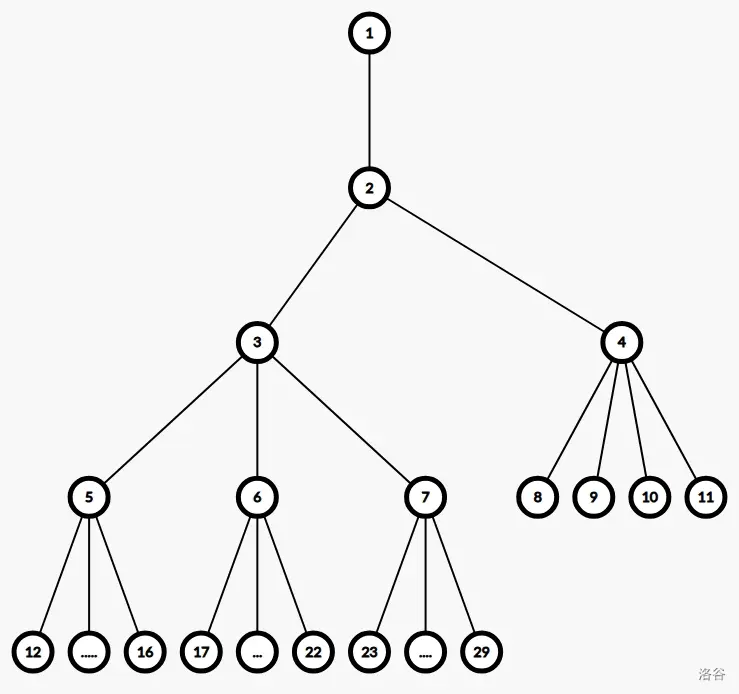
节点 的最小儿子编号应为 ,最大儿子编号是 。分别记为 。
接着观察一个性质:树的层数非常小。
深度 最大节点编号 以此类推,得到下表:
深度 最大节点编号 因此题目中的奇树最多 层。
算法
考虑把一个节点的子树节点编号拆分成若干连续区间。注意到子树每一层都是一个连续区间,所以每个子树可以拆成至多 个区间,例如 的子树可以拆成 ,直到超过 。
现在只需要做如下问题:
给定序列 ,维护区间按位或和区间异或和查询。
这个不需要拆位,可以直接用线段树维护。操作时直接在需要操作的位使用 bitmask,按区间长度奇偶性修改异或和即可。
其实是队友写的线段树我也不知道细节。为了减少空间损耗,我离散化了,需要注意离散化细节,不离散化不知道空间够不够。
代码实现
考场上写了一段时间,调了几下还卡了会空间,封榜后一发过了。
#include <bits/stdc++.h> using namespace std; #define endl '\n' typedef long long ll; const int N = 9e6+9; const int Q = 1e6+9; ll n,q,p,u,c,nOp,pos[Q],nQ,po[N],nPo; struct Operation {ll l,r,c;} op[N]; namespace Seg_Tree { #define int long long int tag[18000005], val[18000005]; void pushdown(int p, int l, int r) { if (!tag[p]) return; if((po[(l + r) / 2 + 1] - po[l]) % 2 == 0) { val[p << 1] = (val[p << 1] ^ (val[p << 1] & tag[p])); } else { val[p << 1] = ((val[p << 1] ^ (val[p << 1] & tag[p])) | tag[p]); } if((po[r + 1] - po[(l + r) / 2 + 1]) % 2 == 0) { val[p << 1 | 1] = (val[p << 1 | 1] ^ (val[p << 1 | 1] & tag[p])); } else { val[p << 1 | 1] = ((val[p << 1 | 1] ^ (val[p << 1 | 1] & tag[p])) | tag[p]); } tag[p << 1] |= tag[p]; tag[p << 1 | 1] |= tag[p]; tag[p] = 0; } void modify(int p, int l, int r, int cl, int cr, int c) { if(l >= cl && r <= cr) { if((po[r + 1] - po[l]) % 2 == 0) { val[p] = (val[p] ^ (val[p] & c)); } else { val[p] = ((val[p] ^ (val[p] & c)) | c); } tag[p] |= c; return; } pushdown(p, l, r); int mid = (l + r) / 2; if(mid >= cl) { modify(p << 1, l, mid, cl, cr, c); } if(mid + 1 <= cr) { modify(p << 1 | 1, mid + 1, r, cl, cr, c); } val[p] = val[p << 1] ^ val[p << 1 | 1]; } int query(int p, int l, int r, int cl, int cr) { if(l >= cl && r <= cr) { return val[p]; } pushdown(p, l, r); int mid = (l + r) / 2, res = 0; if(mid >= cl) { res ^= query(p << 1, l, mid, cl, cr); } if(mid + 1 <= cr) { res ^= query(p << 1 | 1, mid + 1, r, cl, cr); } return res; } } signed main() { ios::sync_with_stdio(0); cin.tie(0); cout.tie(0); cin >> n >> q; while (q--) { cin >> p >> u; if (p == 2) c = 0; else cin >> c; __int128_t l = u,r = u; while (l <= n) { op[++nOp] = (Operation){l, r + 1, c}; po[++nPo] = l; po[++nPo] = r + 1; l = l * (l - 1) / 2 + 2; r = r * (r + 1) / 2 + 1; r = min(r, (__int128_t)n); } if (!c) pos[++nQ] = nOp; } sort(po + 1, po + nPo + 1); nPo = unique(po + 1, po + nPo + 1) - po - 1; ll ans = 0; for (ll i = 1,j = 1; i <= nOp; ++i) { op[i].l = lower_bound(po + 1, po + nPo + 1, op[i].l) - po; op[i].r = lower_bound(po + 1, po + nPo + 1, op[i].r) - po - 1; if (op[i].c) Seg_Tree::modify(1, 1, nPo, op[i].l, op[i].r, op[i].c); else ans ^= Seg_Tree::query(1, 1, nPo, op[i].l, op[i].r); if (j <= nQ && i == pos[j]) cout << ans << endl,ans = 0,++j; } return 0; } -
0
题意
定义一棵无限大的树,设其 bfs 序为 ,则 有 个子节点, 有 个子节点, 有 个子节点。
我们只保留其中的前 个点,然后给每个点赋一个初始 的值。要求支持 次两种操作:
- 给定 ,将 子树内所有点的值都二进制或上 。
- 给定 ,求 子树内所有点的值的二进制异或和。
,,。
Part 1
经过打表可以发现,前 个点的树高最多为 。具体的,以下是每一层的编号最小的点的编号:
1             // 1
2             // 2
3             // 3
5             // 4
12            // 5
68            // 6
2280          // 7
2598062       // 8
3374961778893 // 9
并且前 层的点数只有 左右。
接下来的运算我们可能需要两个核心函数:
-
求点 的父节点。对前 层的节点进行预处理,后面的可以二分。
具体的,设 ,则 的直系儿子中编号最大的点编号为 。依此就可以在 的复杂度内完成二分。
-
求点 的子树大小(的奇偶性)。可以发现,这个子树在每一层都占据了连续的一段编号。因此,我们维护 ,转移到下一层即 。
注意判断这个区间和 的关系,并且注意运算过程中可能会爆
long long,需要使用__int128_t。
Part 2
考虑 怎么做。那么,对于一个点 ,如果其到根路径上有任意一个点被操作了,那么它此时的子树异或和就是子树大小的奇偶性。
否则,因为树高很小,我们可以尝试在操作 的时候,更新对它的所有祖先的答案的影响。具体的,设 表示子树的异或和,那么,在更新 时,我们先求出原来的 ,然后再求出新的 (在这里就是子树大小奇偶性),那么我们要对 到根上的所有 都异或上 。
注意一个 在“ 到根路径上有点操作过”的时候的值是无意义的。
可以发现这个过程可以做到 ,其中 为树高。
Part 3
回到原题,如果直接拆位的话那复杂度会多一个 ,不太能过。
仍然用 Part 2 的做法。另设 表示在 应用过的所有 的或和(不是异或和)。那么此时 的子树和可以表述为:(不太会用 打这个东西)
(s[x] & ~t[x]) | (t[x] * siz(x))其实就是将操作过的位置忽略掉,然后再用子树大小把真正的值赋上。具体存的时候只会存直接应用的值 ,要求定义的 只需将到根路径上的所有 或起来即可。
对于一个 ,我们可以直接忽略那些已经操作过的位。那么,剩下的位处理就和 Part 2 一模一样了。此时的 可以表示为:
(query(x) & c) ^ (c * siz(x))因此也可以做到 。
因为要存 ,实现过程可能需要用到
umap,反正没卡就过了。#include <unordered_map> #include <iostream> using namespace std; #define MAXN 5000006 using ll = long long; ll n; int fa[MAXN]; ll dl[10] = { 0, 1, // 1 2, // 2 3, // 3 5, // 4 12, // 5 68, // 6 2280, // 7 2598062, // 8 3374961778893, // 9 }; ll qfa(ll p) // 获得父节点 { if (p < dl[8]) { return fa[p]; } int cd = p < dl[9] ? 7 : 8; ll l = dl[cd], r = dl[cd + 1] - 1; while (l < r) { ll mid = (l + r) >> 1; if ((__int128_t)mid * (mid + 1) / 2 >= p) { r = mid; } else { l = mid + 1; } } return l; } unordered_map<ll, int> mp; int mid = (int)dl[8] - 1; int id(ll p) { if (p < dl[8]) { return (int)p; } else if (!mp.count(p)) { return mp[p] = ++mid; } return mp[p]; } ll tag[MAXN], sum[MAXN]; bool siz(ll p) // 子树大小的奇偶性 { bool res = 1; __int128_t l = p, r = p; while (true) { l = l * (l - 1) / 2 + 2; r = r * (r + 1) / 2 + 1; if (r >= n) { if (l > n) { return res; } return res ^ ((n - l + 1) & 1); } res ^= (r - l + 1) & 1; } return 0; } ll query(ll p) { ll res = sum[id(p)], ta = 0; for (ll q = p; q; q = qfa(q)) { ta |= tag[id(q)]; } return (res & ~ta) | (ta * siz(p)); } void modi(ll p, ll c) { ll ta = 0; for (ll q = p; q; q = qfa(q)) { ta |= tag[id(q)]; } c &= ~ta; ll nv = (c * siz(p)) ^ (query(p) & c); tag[id(p)] |= c; for (ll q = p; q; q = qfa(q)) { sum[id(q)] ^= nv; } } int main() { int q; cin >> n >> q; int cur = 1; for (int i = 1; i < dl[8]; i++) { bool end = false; for (int j = 1; j <= i; j++) { fa[++cur] = i; if (cur == dl[8] - 1) { end = true; break; } } if (end) { break; } } while (q--) { int o; ll x, c; cin >> o >> x; if (o == 1) { cin >> c; modi(x, c); } else { cout << query(x) << '\n'; } } return 0; }
- 1