
1 条题解
-
0
本题属于 最短路 题,但较模板题还是有很大区别的。
我们可以视一条管道为一条边,然后对于每一条边保存连接的端点 以及管道的花费 和管道的流量 。
本文中将 的含义视为一条边的权值或两点之间的距离。
若视 Farmer John 的整个管道网络为一个图,则样例所表示的图如下:
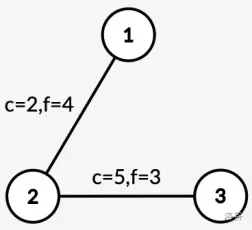
题目让我们求出从 到 中, 的最大值。
从上图来看,我们只能选择 的路径。这样,最大值为 。所以输出为 。
我们不妨在样例的基础上增加一条边:
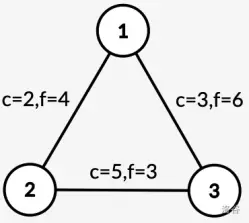
附加新输入:
3 3
2 1 2 4
2 3 5 3
1 3 3 6
则我们应当考虑路径 和 。刚才已经分析了 路径的答案,即 。而 路径的答案为 。由于 ,所以 比 更优,输出 。
由于每个端点的 都有可能成为所有的 值的最小值,因而我们可对哪一条边的 满足 进行枚举。
保证 后,再找最小的 即可,这样需要跑 次 。
时间复杂度:
#include<bits/stdc++.h> using namespace std; int n,m,cnt,head[1001],dis[1001],F[1001]; // 记录所有边的 f 值 double ans; // 保存最优解的值 bool vis[1001]; struct edge { int nxt,to,w,f; }e[2001]; struct node { int pos,dis; bool operator<(const node &x)const // 从小到大为优先队列默认排序方式 { return dis>x.dis; } // 重载运算符,把 dis 小的放在前面,但由于 priority_queue 的性质,需要颠倒过来 }; void add(int u,int v,int w,int f) // 链式前向星存边 { e[++cnt].nxt=head[u]; e[cnt].to=v; e[cnt].w=w; // 这里用 w 代替 c,符合常规习惯 e[cnt].f=f; head[u]=cnt; } int dijkstra(int s,int minf) { memset(dis,0x3f,sizeof(dis)); // 重置所有点到 1 的总距离(即所有 c 值总和)为 0x3f3f3f3f memset(vis,false,sizeof(vis)); // 多次 dijkstra 要清空 vis 数组 dis[s]=0; // 源点距离赋值为 0 priority_queue<node>Q; Q.push((node){s,0}); // 将源点的数据压入队列中 while(Q.size()) { int x=Q.top().pos; // 取队列元素所表示的端点编号 Q.pop(); // 将该元素弹出 if(vis[x])continue; vis[x]=true; // 判断是否被访问 + 标记访问 for(int i=head[x];i;i=e[i].nxt) // 运用链式前向星的性质遍历 { int y=e[i].to; if(e[i].f<minf)continue; // 如果该边的 f 值小于本次 dijkstra 所枚举的 minf 值,则跳过该边 if(dis[y]>dis[x]+e[i].w) // 按照模板找最小距离 { dis[y]=dis[x]+e[i].w; if(!vis[y])Q.push((node){y,dis[y]}); } } } return dis[n]; } int read() { int x=0; char ch=getchar(); while(ch<'0'||ch>'9')ch=getchar(); while(ch>='0'&&ch<='9') { x=(x<<1)+(x<<3)+(ch^48); ch=getchar(); } return x; } int main() { n=read(),m=read(); for(int i=1;i<=m;i++) { int u=read(),v=read(),c=read(),f=read(); add(u,v,c,f); add(v,u,c,f); // 无向图,需存两次边 F[i]=f; } for(int i=1;i<=m;i++)ans=max(ans,1e6*F[i]/dijkstra(1,F[i])); // 把 ans 值赋值为当前枚举到的 minf 和 dijkstra 后得到最小距离的商的 1e6 倍 printf("%d",int(ans)); // 下取整输出答案 return 0; }实际上,我们在 的过程中,可以在边的结构体再加一些变量来保存 和 ,并用浮点类型记录 的值。
时间复杂度:
#include<bits/stdc++.h>
using namespace std;
int n,m,cnt,head[1001];
double dis[1001];
bool vis[1001];
struct edge
{
    int nxt,to,w,f;
}e[2001];
struct node
{
    int pos,f,dis;
    // f 保存遍历过程中,经过的 f 值中最小的
    double d;
    // 比前一份代码中多了 d 和 f 两个变量,实际上 d = f / dis
    bool operator<(const node &x)const
    {
        return d<x.d;
    }
    // 实际上应该让 d 更大的在前面,但与前面同理,需要颠倒
};
void add(int u,int v,int w,int f)
{
    e[++cnt].nxt=head[u];
    e[cnt].to=v;
    e[cnt].w=w;
    e[cnt].f=f;
    head[u]=cnt;
}
double dijkstra(int s)
{
    memset(vis,false,sizeof(vis));
    priority_queue<node>Q;
    Q.push((node){s,0x3f3f3f3f,0,0});
    // 源点编号为 s,而 f 的最小值应当设为 0x3f3f3f3f
    while(Q.size())
    {
        int x=Q.top().pos,f=Q.top().f,d=Q.top().dis;
        Q.pop();
        if(vis[x])continue;
        vis[x]=true;
        for(int i=head[x];i;i=e[i].nxt)
        {
            int y=e[i].to,nd=d+e[i].w,nf=min(f,e[i].f);
            // nd 记录编号 1 和 y 两个点之间的距离
            // nf 取当前 f 值和之前所有 f 值中最小的
            if(1.0*nf/nd>dis[y]) // 我们要求的是最大的 nf/nd,所以按照这个值的大小进行松弛
            {
                dis[y]=1.0*nf/nd;
                if(!vis[y])Q.push((node){y,nf,nd,dis[y]});
            }
        }
    }
    return dis[n];
}
int read()
{
    int x=0;
    char ch=getchar();
    while(ch<'0'||ch>'9')ch=getchar();
    while(ch>='0'&&ch<='9')
    {
        x=(x<<1)+(x<<3)+(ch^48);
        ch=getchar();
    }
    return x;
}
int main()
{
    n=read(),m=read();
    for(int i=1;i<=m;i++)
    {
        int u=read(),v=read(),c=read(),f=read();
        add(u,v,c,f);
        add(v,u,c,f);
    }
    printf("%d",int(1e6*dijkstra(1))); // 直接输出跑一次 dijkstra 得到的值即可
    return 0;
}
祝大家 !
- 1
