
2 条题解
-
0
按顺序,交替地,记录下多边形的边角信息。
例如样例中的第二个多边形:
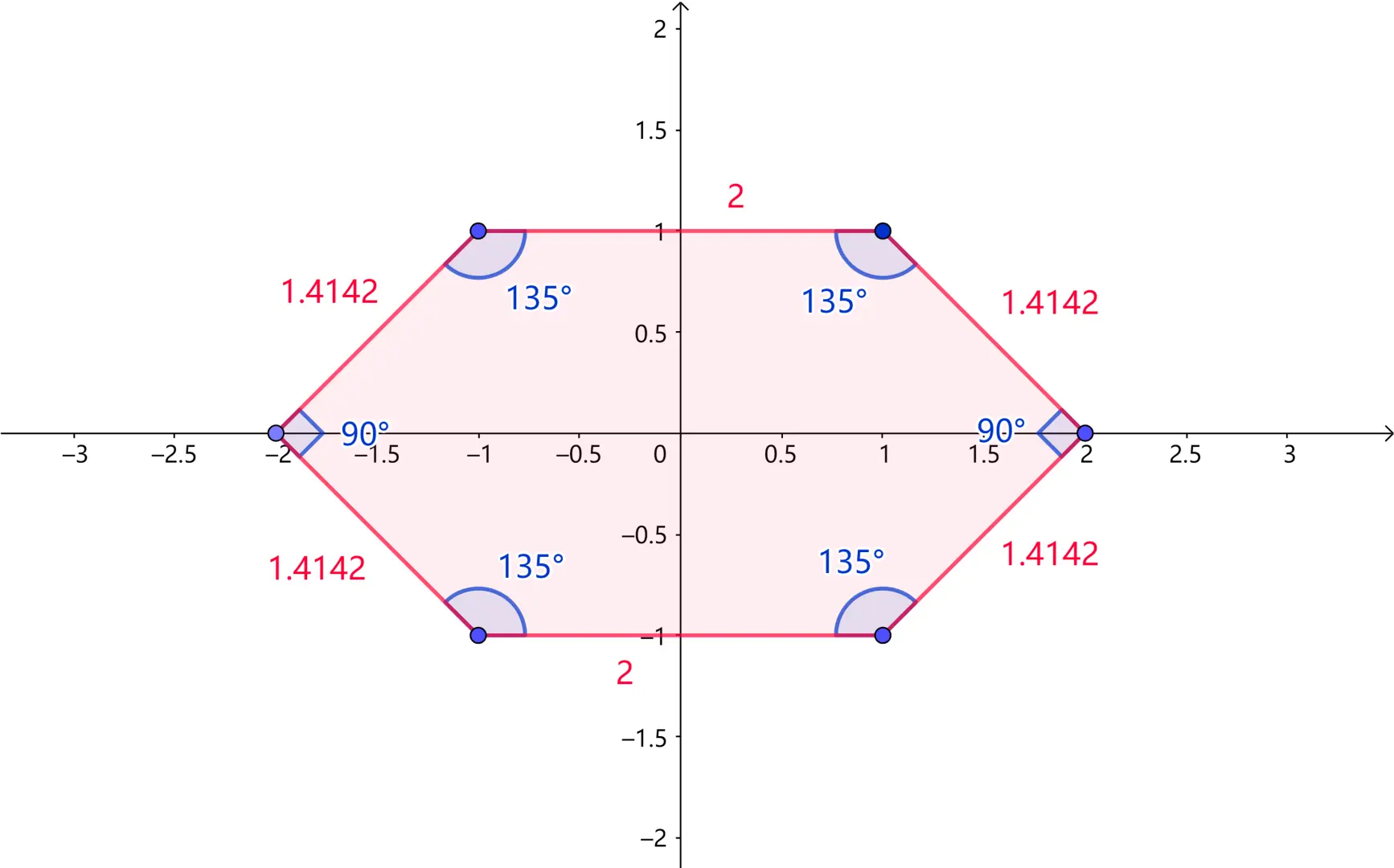
以右下角为起点,逆时针交替记录边角,得到长度为 的序列:
$$\sqrt2\to90\degree\to\sqrt2\to135\degree\to2\to135\degree\to\sqrt2\to90\degree\to\sqrt2\to135\degree\to2\to135\degree$$这里的序列可以看作一个环,最后一项连向第一项。
角度与边长都是实数,不好处理。不如使用两条边向量的叉积代替角度,用边长的平方代替边长,这样就以将实数环转化为整数环:
$$2\to\underline2\to2\to2\to\underline4\to2\to2\to\underline2\to2\to2\to\underline4\to2$$此时,原多边形有几条对称轴即可转化为下列问题:环上有几个位置,满足将环从这里断开后,可以得到一条回文链?
在这个样例中,共有 个位置满足条件,因此多边形有 个对称轴(一条对称轴穿过两个位置)。
现在,我们把一个计算几何问题转化成了字符串问题。而本题解的创新之处在于返璞归真地用哈希解决了问题:我们将原长为 的序列倍长为 ,然后对于每个 ,检查区间 是否为回文串(断环成链)。回文串的检查可以用哈希优化至 ,也就是对于原串正反分别做一次哈希,然后判断该区间的正反哈希值是否相等即可。
#include<bits/stdc++.h> #define nb 400010 #define int long long using namespace std; int _, n, s[nb]; unsigned int B = 131, H1[nb], H2[nb], P[nb] = {1}; struct point{int x, y;}p[nb]; bool check(int l, int r){ unsigned int h1 = H1[r] - H1[l - 1] * P[r - l + 1]; unsigned int h2 = H2[l] - H2[r + 1] * P[r - l + 1]; return h1 == h2; // 正反哈希值相等说明回文 } signed main(){ for(int i = 1; i < nb; i++) P[i] = P[i - 1] * B; for(cin >> _; _--;){ cin >> n; int ans = 0; for(int i = 1; i <= n; i++) cin >> p[i].x >> p[i].y; for(int i = 1; i <= n; i++){ int A = i, B = i + 1, C = i + 2; B -= (B > n) * n, C -= (C > n) * n; s[i * 2 - 1] = pow(p[A].x - p[B].x, 2) + pow(p[A].y - p[B].y, 2); s[i * 2] = (p[A].x - p[B].x) * (p[B].y - p[C].y) - (p[A].y - p[B].y) * (p[B].x - p[C].x); // s[2i - 1] 和 s[2i] 分别记录边角信息 // 叉积公式: (a, b) × (c, d) = ad - bc } for(int i = 1; i <= n * 2; i++) s[i + n * 2] = s[i]; // 断环成链 for(int i = 1; i <= n * 4; i++) H1[i] = H1[i - 1] * B + s[i]; // 正向哈希 for(int i = n * 4; i >= 1; i--) H2[i] = H2[i + 1] * B + s[i]; // 反向哈希 for(int i = 1; i <= n * 2; i++) ans += check(i, i + n * 2); // 判断回文 cout << ans / 2 << endl; // 答案除二 } return 0; } -
0
 huangzheng
LV 6
@ 2025-10-8 17:02:51
huangzheng
LV 6
@ 2025-10-8 17:02:51
#include<bits/stdc++.h>
using namespace std;
typedef unsigned long long ULL;
template<typename T>void qr(T& x)
{
	x=0;int f=1;char c=getchar();
	for( ;!isdigit(c);c=getchar())if(c=='-')f=-1;
	for( ; isdigit(c);c=getchar())x=x*10+c-48;
	x=x*f;
}
const int N=4e5+10;
const ULL B=131;
ULL f1[N],f2[N],d[N],s[N];

struct point{int x, y;}P[N];
bool check(int l, int r)
{
	ULL h1=f1[r]-f1[l-1]*d[r-l+1];
	ULL h2=f2[l]-f2[r+1]*d[r-l+1];
	return h1==h2;	// 正反哈希值相等说明回文
}
int main()
{
	d[0]=1;for(int i=1;i<N;i++)d[i]=d[i-1]*B;
	int T;qr(T);
	while(T--)
	{
		int n;qr(n);for(int i=1;i<=n;i++)qr(P[i].x),qr(P[i].y);
		for(int i=1;i<=n;i++)
		{
			int a=i, b=i+1, c=i+2;b-=(b>n)*n;c-=(c>n)*n;
			s[i*2-1]=(P[a].x-P[b].x)*(P[a].x-P[b].x)+ (P[a].y - P[b].y)*(P[a].y - P[b].y);
			ULL x1,y1,x2,y2;
			x1=P[b].x-P[a].x;
			y1=P[b].y-P[a].y;
			x2=P[c].x-P[b].x;
			y2=P[c].y-P[b].y;
			s[i*2]=x1*y2-y1*x2;
		}
		for(int i=1; i<=n*2;i++) s[i+n*2]=s[i];		  // 断环成链
		f1[0]=0;    for(int i=1; i<=n*4;i++) f1[i]=f1[i-1]*B+s[i]; // 正向哈希
		f2[n*4+1]=0;for(int i=n*4;i>=1;i--)  f2[i]=f2[i+1]*B+s[i]; // 反向哈希
		int ans=0;for(int i=1; i<=n*2;i++) ans += check(i,i+n*2);	  // 判断回文
		printf("%d\n",ans/2);									  // 答案除二
	}
	return 0;
}
- 1
